
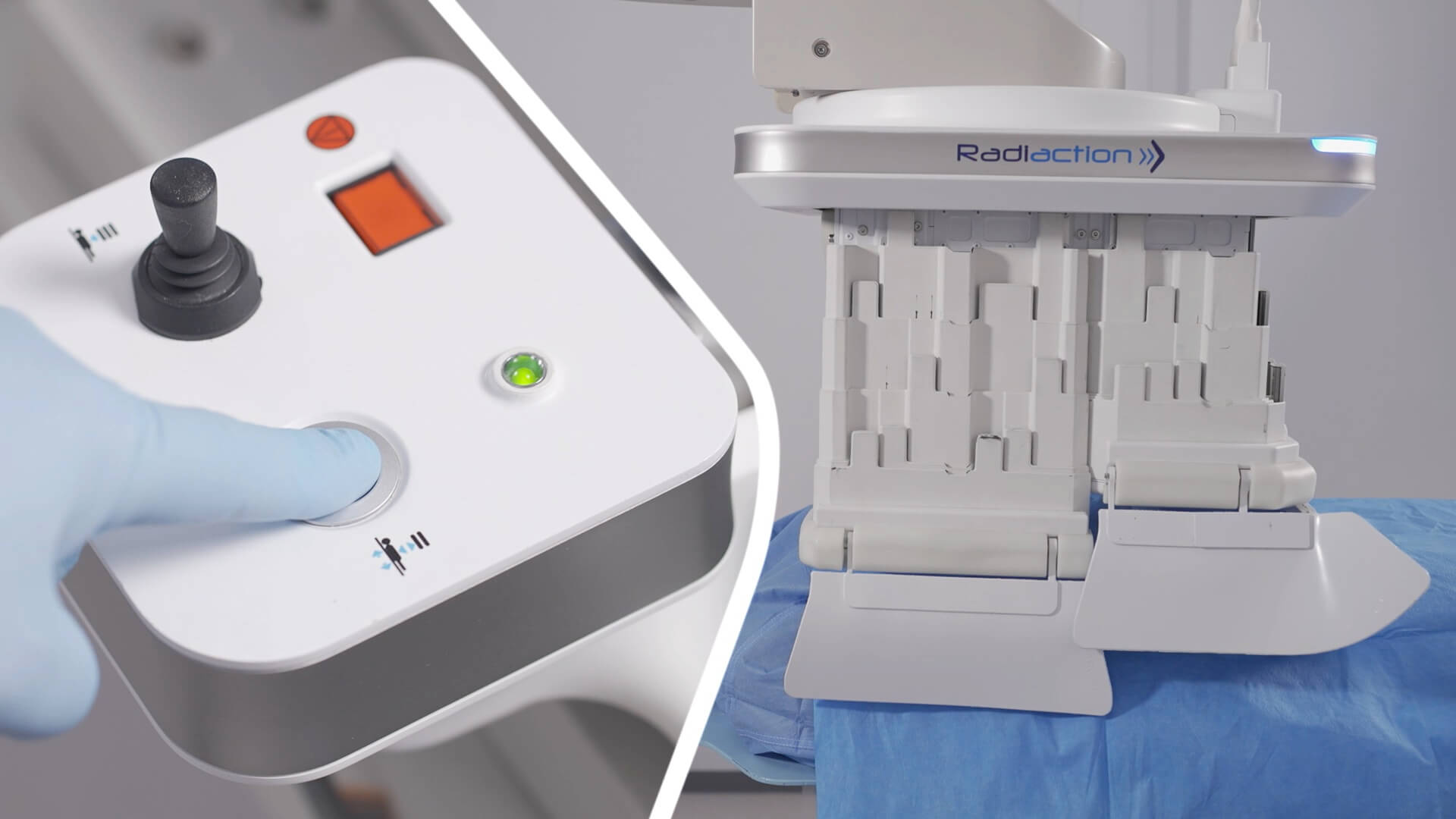
Among those concerned with medical radiation safety, there’s been a lot of buzz lately about various approaches to breaking free from traditional lead shielding. Some manufacturers imply their products render wearable shielding unnecessary. Others tout their offerings as requiring less lead than previously required. Often, though, these claims refer to stand-alone devices that protect specific staff in circumscribed areas. While the overarching goal is a safe lead-free catheterization lab, what does that really mean?
According to Michael S. Gossman, a member of our Medical Advisory Board and Chief Medical Physicist and Radiation Safety Officer in the Department of Radiation Oncology at Baptist Health Floyd in New Albany, Indiana:
Nearly all clinics operate in a static environment. In general, staff are confined to the boundaries of the room where radiation is emitted. Using classical teachings, staff should know how to use the principles of time, distance, and shielding to reduce their doses. For most, exposure time depends on their function in the room as well as the duration of the case, designed by the physician. Distance is usually assigned to them at a position in the room where they conduct their work. Shielding has traditionally been some form of wearable personal protective equipment (PPE) when in the room, or perhaps a standing shield or a console with a lead-embedded clear window if positioned away from the table. In either scenario, the shielding is always in the same or similar position with little to no adjustment. At Radiaction Medical, they focus on transforming traditional technology and advancing it to deliver long-term solutions to these oversights, while incorporating pseudo-driven automation to assist users.
We believe the solution is about a constellation of factors — some technological, some sociological — seamlessly working in harmony to create a comprehensive protective environment that covers everyone throughout the lab, consistently providing the freedom they need to fully focus on their life-saving work. While innovative technology is fundamental, a truly successful solution requires considering the human side of the equation.
This begins with healthcare institutions supporting a culture of shared responsibility for cath lab radiation safety. All parties must be involved — from administrators and cath lab directors to physicians, technicians, nurses, and all other staff in the room. Each must understand the problem and commit to working together to solve it. Without everyone on board, even the most advanced technology will not work. But that technology must also accommodate the people tasked with using it. Unwieldy, inconvenient, or time-consuming machines or processes disrupt critical workflows and will eventually be worked around rather than used consistently.
With the Radiaction Dynamic Smart Shield at its core, the lead-free cath lab can be a reality that springs from an overlapping multi-faceted approach to radiation shielding, one that ensures safety throughout the room without sacrificing staff wellness or efficient workflow, guaranteeing the four freedoms that every cath lab worker deserves.
1. FREEDOM FROM UNNECESSARY EXPOSURE
After more than a century in use, the dangers of medical radiation are well studied, especially when it escapes from fluoroscopes and scatters about the room. While a patient generally receives the highest dose, this exposure lasts only during the procedure. For healthcare providers and staff who work alongside fluoroscopes, indirect radiation exposure can lead to injuries when experienced day in and day out over a career. Brain tumors, breast cancer, cataracts, thyroid disease, cognitive degradation, and fetal exposure are among the documented risks. To make matters worse, the traditional means of shielding staff from that primary danger causes its own problems. Wearable lead-lined apparel, usually in the form of heavy aprons, can cause distracting fatigue and soreness. Over the long haul, they can lead to debilitating, career-ending orthopedic injuries to the back and neck. And scatter radiation can still find gaps in the shielding or enter the body through exposed faces and hands.
Chief Michael Gossman added:
This is precisely why it has been traditionally important to have protective shielding. The old school means of wearing a lead apron of 0.25 mm thickness can reduce radiation exposure by as much as 90%. Similarly, lead-lined goggles can reduce eye doses by up to 83%. We aim to go beyond those limits with the Radiaction technology by reducing unnecessary exposure for staff, regardless of their position in the cath lab.
The search for a solution to these problems is what led to the development of the Radiaction Dynamic Smart Shield. The system deploys robotically at the touch of a button and blocks scatter radiation at the source. When paired with the latest lead-free, lightweight wearable shielding, exposure levels can be further reduced, freeing cath lab staff from the health risks that have plagued them for decades.
2. FREEDOM FROM INCONVENIENCE AND EXCESSIVE WEIGHT
Any technology designed to interface with human beings succeeds only when it prioritizes and addresses their preferences, nature, and physicality. We’ve learned over and over that a technological solution that causes delays, inconvenience, discomfort, or annoyance winds up being no solution at all, as intended users are inclined to avoid it. This fundamental fact guided the development of the Radiaction Dynamic Smart Shield and continues to steer its evolution and refinement. From the outset, the system was designed to seamlessly integrate into procedural workflows. Its rapid deployment and retraction allow for immediate access to the patient, moving quickly out of the way so that potentially life-saving interventions are neither delayed nor obstructed. As a component of the C-arm, the Radiaction system blocks scatter radiation at the source before it enters the room, across the full range of orientations and aspects, so imaging functionality is fully preserved while reducing scatter radiation for medical staff in the room.
When used in combination with Burlington Medical’s lightweight, wearable EtherealShield garments, scatter radiation is further reduced. At 0.125mm thickness, its proprietary lead-free Xenolite NL® construction reduces weight by up to 55% over traditional 0.5mm and 0.35mm lead aprons. This minimizes musculoskeletal strain and injury, enhancing mobility, blood circulation, and endurance during long procedures. Burlington’s customizable, well-fitting aprons pair exceptionally well with Radiaction’s full-room technology, stacking protection, and freeing cath lab workers from pain, strain, and workflow disruptions.
3. FREEDOM FROM ENVIRONMENTAL TOXICITY
While effective at blocking radiation, lead has drawbacks beyond its inherent heaviness. It is a well-known environmental toxin, and direct exposure or ingestion can cause a variety of frightening health effects all on its own. Although contact with the lead in shielding and apparel can be prevented by good design, it remains a danger during manufacturing and eventual disposal processes. At some point, that lead will make its way into our environment, so limiting it has been a priority for a long time. Only recently has the prospect of eliminating all lead from radiation shielding become a reality. With remarkable advancements in materials science, lead can now be replaced with innovative applications of tungsten, bismuth, antimony, tin, titanium, and other non-toxic substances. These new shielding materials are essential components of both Radiaction’s Dynamic Smart Shield and Burlington’s EtherealShield aprons, and at the end of each unit’s life cycle can be reprocessed and reused free from health or environmental risks.
4. FREEDOM FROM WORRY
Ultimately, the combination of the first three freedoms is what produces the fourth. In a supportive institutional environment coupled with the Radiaction Dynamic Smart Shield and EtherealShield apparel, informed cath lab workers know that they’re protected and unencumbered. Free from worrying about their own health and that of their coworkers — and free from the distractions and inconvenience of poorly designed technology — they can do the work for which they’ve invested so much of their professional lives: healing patients with life-threatening health problems. This freedom from worry, while difficult to quantify, may wind up having the most powerful beneficial impact of all.
Further insights from Chief Michael Gossman:
The innovation of Radiaction Medical is a true testament to engineering with an emphasis on the ALARA (As Low As Reasonably Achievable) approach. Here, we first considered what was reasonably achievable. Now, after years of testing, we can provide the medical community with results showing that this technology delivers the lowest possible dose.
Beyond the typical narratives, Radiaction Medical’s compelling three-tiered approach is designed to offer a safer alternative to outdated or incomplete efforts to eliminate the serious health risks posed by fluoroscopic scatter radiation. With FDA Class II clearance for its latest full-room protective Dynamic Smart Shield, partnership with Burlington Medical and their next-level shielding apparel, and an educated and supported healthcare workforce enthusiastically embracing these modern tools, a truly lead-free cath lab is no longer just a goal, it’s a reality whose time has come.
Michael S. Gossman, M.S., DABR, FAAPM, FACR, is the Chief Medical Physicist in the Department of Radiation Oncology at Baptist Health Floyd in New Albany, IN. Chief Gossman is a Diplomate of the American Board of Radiology, receiving his education as a Medical Physicist at the University of Louisville and Vanderbilt University. His training, experience, and expertise in radiological protection and regulations are extensive. He was notably a multiple-term Medical Consultant for the U.S. NRC. He has been recognized as a "Fellow" by the AAPM and the ACR. He is well-known and well-published and has assisted more than 15 different companies in the industry as a consultant.