
Protecting Staff From Scatter Radiation
The Radiaction Dynamic Smart Shield is a groundbreaking solution designed to proactively block radiation at the source, ensuring the utmost protection for the interventional room. Radiaction is clinically supported with extensive lab testing and real-world, peer-reviewed, published literature validating its performance in live clinical settings. The system’s fast, effortless, dynamic operation maintains workflow efficiency and allows complete access to patients during the cath lab procedures.
First Evaluation in the Clinical Environment
The first real-world clinical use of the Radiaction system was evaluated in PCI catheterization and Electrophysiology (EP) laboratories. The radiation reduction was done throughout the room for PCI and EP procedures (Including CIED).

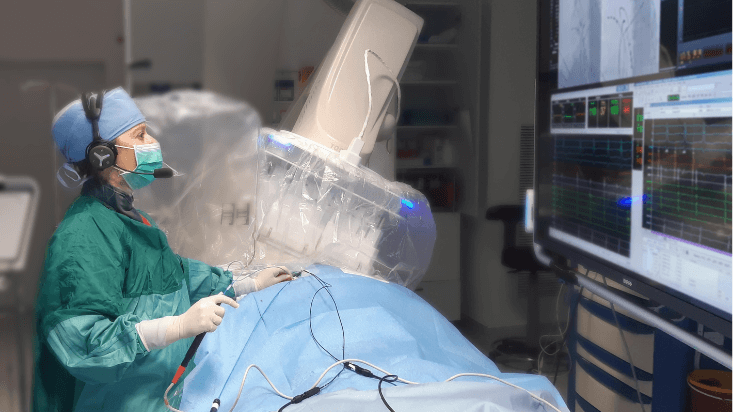

A Novel Robotic Radiation Shielding Device for Interventional Cardiology Procedures
Avishag Laish-Farkash1, MD, PhD; Emanuel Harari1, MD; Ariel Finkelstein2, MD; Guy Sheinman1, MD; Michael Rahkovich1, MD; Yonatan Kogan1, MD; Eli Israel Lev1, MD
1. Cardiology Department, Assuta Ashdod University Medical Center, Ben-Gurion University of the Negev, Ashdod, Israel; 2. Cardiology Department, Tel Aviv Sourasky Medical Center, Tel Aviv University, Tel Aviv, Israel
Introduction
Fluoroscopy-guided interventional procedures are the leading source of occupational ionising radiation exposure for medical personnel1. The prevailing radiation protection measures for interventional personnel include: reduced radiation imaging systems, personal protective clothing, ceiling-mounted shields and table-skirts. However, interventional personnel continue to be exposed to high cumulative doses of X-ray radiation, which may increase the risk for malignancies1, early development of cataracts2, and orthopaedic problems due to the heavy weight of lead aprons3.
Newer dedicated solutions, such as suspended radiation protection systems4 and a remote-controlled robotic system5,6, provide protection only to the main operator, limit free movement (zero-gravity) and require...

A Novel Robotic Radiation Shielding Device for Electrophysiologic Procedures: A Prospective Study
Avishag Laish-Farkash, MD, PhD1, Emanuel Harari, MD1, Michael Rahkovich, MD, Yonatan Kogan, MD, Gergana Marincheva, MD, Guy Scheinman, MD, Eyal Ben-Assa, MD, and Eli I. Lev, MD Ashdod, Israel
Introduction
Fluoroscopy-guided procedures are the leading source of occupational ionizing radiation exposure for electrophysiologic (EP) personnel.1 High cumulative doses of X-ray radiation might increase the risk for malignancies,1 early development of cataracts,2 and orthopedic problems due to the heavy weight of lead aprons.3 Reducing high radiation exposure during medical procedures is the principal task of many professional societies and advisory groups.4,5

Evaluation of a First of a Kind Robotic Radiation Protection Technology to Reduce Scatter Exposure During Diagnostic Procedures and Percutaneous Coronary Interventions
Wojciech E. Krzyzanowski*, Pawel Radecki, Marta K. Szczerbinska, Kamil Dawidczyk, Mikołaj Kosek, Krzysztof Romanik, Wojciech Suchcicki, Dariusz Karwowski, Paweł R. Natkowski
Introduction
Radiation exposure remains a pivotal occupational concern in medical procedures, particularly during fluoroscopy-guided cases such as IC. While various imaging devices are crucial in treating patients, C-arm fluoroscopic machines maintain widespread use due to their ability to assess bone structure, intravascular injections, and needle placement regardless of gauge or insertion angle. This study evaluated the effectiveness of the Radiaction system in providing comprehensive protection to medical personnel during fluoroscopy-guided procedures in an Interventional Cardiology (IC) laboratory. The system confines the imaging beam to block scatter radiation at the source, enhancing safety for the Cath lab staff.

Robotic Radiation Shielding System Reduces Radiation-Induced DNA Damage in Operators Performing Electrophysiological Procedures
Ziv Sevilya1,4, Michael Rahkovich1, Yonatan Kogan1, Gergana Marincheva1, Michal Cipok2, Vera Hershkovitz2, Erez Barenboim3,4, Eli Israel Lev1,3 & Avishag Laish-Farkash1,3
Introduction
Fluoroscopically guided electrophysiology (EP) procedures expose operators to low doses of ionizing radiation, which can induce DNA double-strand breaks (DSBs) and raise increasing concerns regarding potential health risks. A novel robotic radiation shielding system (RSS) was developed to protect medical staff by encapsulating the imaging beam and blocking scatter radiation. This study aimed to compare the levels of blood lymphocytes expressing DSB markers, pATM and γ-H2AX, in operators performing EP procedures with and without RSS.

Innovative Radiation Protection System Enables Reduction in the Weight Of Lead Aprons During Electrophysiological Procedures
Avishag Laish-Farkash1, Michael Rahkovich1, Yonatan Kogan1, Gergana Marincheva1, Eyal Ben-Assa1, Ariel Roguin2, Eli I. Lev1
Introduction
Advances in medical technology have increased the use of ionizing radiation in cardiology, particularly in electrophysiology (EP) laboratories and cardiac catheterization laboratories (CCL). While essential for diagnostic and interventional EP procedures, radiation exposure poses long-term risks to medical personnel, including increased malignancy risks, early cataract development, and DNA damage [1, 2]. Indeed, the most active interventional and EP cardiologists had exposures equating to an excess lifetime risk of cancer of 1 in 100 [3], and they are at high risk of developing radiation-induced cataracts [4]. The long-term effects of occupational X-ray radiation on staff can be mitigated by adopting proper radiation protection measures, such as lead aprons and other protective gear [5].
Know the Risks to the Healthcare Team
In the interventional suite, daily radiation exposure puts physicians and staff at significant risk for radiation-based complications such as cataracts, cognitive degradation, tumors, cancers, thyroid disease, cardiovascular diseases, and fetal exposure. On top of this, the standard heavy lead aprons physicians and staff currently use can lead to an array of orthopedic problems while only offering partial protection.

University of California San Diego Health System
“I think that radiation is a concern when you look at women choosing cardiology and EP as a sub-specialty…there are a number of barriers going into the field, but radiation comes up as a concern every time we talk about this. It’s a very real phenomenon, and women think about it before choosing a specialty.”
Dr. Ulrika Birgersdotter-Green, Cardiac Electrophysiologist and Cardiologist
Education in Innovative Radiation Protection Technology
Is radiation in your lab as low as reasonably achievable (ALARA)? Have confidence that Radiaction will help you minimize your exposure to scatter radiation and stay below your dose limits.
There are three ALARA safety measures to focus on:
*Center for Disease Control and Prevention (2022).
*Jaquith, K. (2018). The ALARA Principle: 3 Safety Measures To Follow.
*College of Physicians and Surgeons and the Alberta College of Medical Diagnostic and Therapeutic Technologists.